SERENGETI NATIONAL PARK
The Ultimate Guide to the Land of Endless Plains
Destination Type: Wildlife Safari | UNESCO World Heritage Site
Location: Northern Tanzania, Africa
Famous For: The Great Wildebeest Migration, The Big Five, Endless Savannah Plains
Why the Name "Serengeti"?
The name “Serengeti” evokes mystery and vastness. Derived from the Maasai language, it comes from the word “Siringet,” which poetically translates to “the place where the land runs on forever” .
When the first explorers arrived, they stood on the plains and understood immediately why the Maasai chose that name. There are no fences, no borders, just an endless horizon of grass, acacia trees, and sky. The park was officially established in 1951, and in 1981, it was designated a UNESCO World Heritage Site for its natural beauty and ecological importance .
Where is it Located?
Serengeti National Park is located in Northern Tanzania, bordering Kenya to the north, where it joins the Maasai Mara National Reserve. The park spans an immense area of 14,750 square kilometers (5,700 square miles) across the Mara and Simiyu regions .
Nearest Major City: Arusha (Approx. 320 km / 200 miles east)
Access Points: There are several entry gates, including the main Naabi Hill Gate in the southeast, as well as Ndabaka Gate (west) and Klein’s Gate (northeast) .
Geography & The Four Main Regions
The Serengeti is not just one uniform landscape. It is divided into distinct geographical zones, each offering a different safari experience:
The Southern Plains (Ndutu Area): Vast, open grassland. The landscape is almost treeless here, offering spectacular views.
The Western Corridor: A lush, riverine area following the Grumeti River. Dense forests and river banks dominate.
The Northern Serengeti (Kogatende/Lamai): Characterized by rolling hills, woodlands, and the dramatic Mara River, which has steep banks.
The Central Serengeti (Seronera): The “Heart” of the park. This area features a mix of savannah and the famous Kopjes (granite rock outcroppings) that serve as excellent vantage points for lions and leopards .
Tourist Attractions & Wildlife
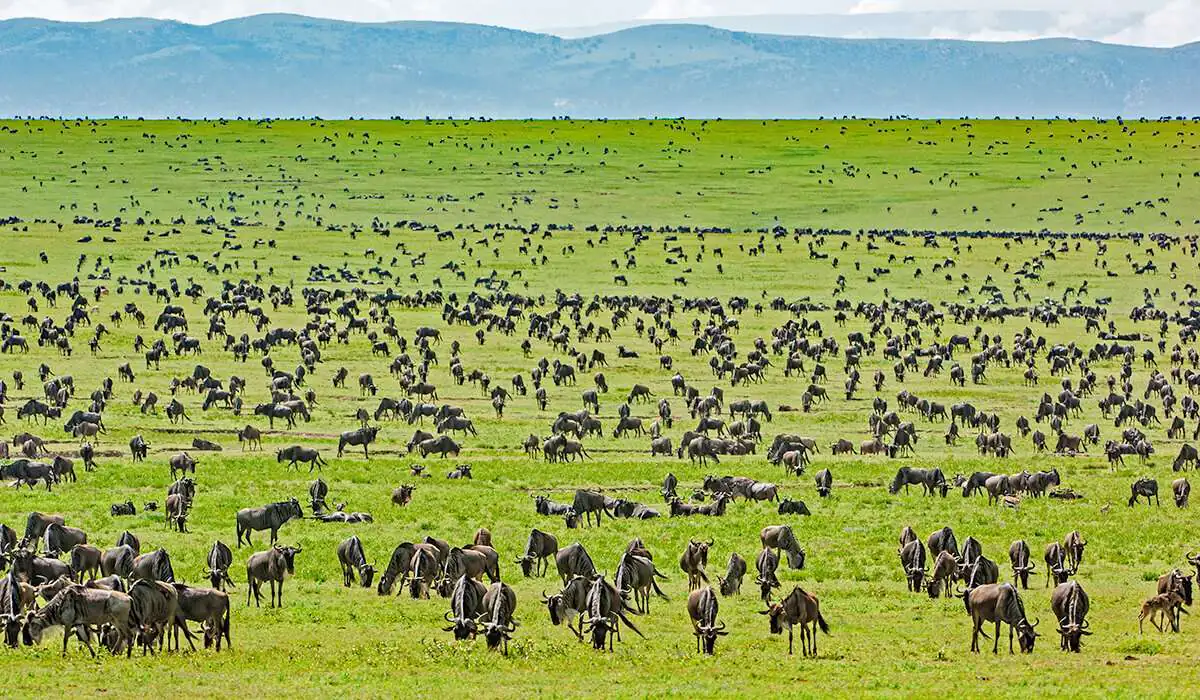
The Great Wildebeest Migration: Often called “The World Cup of Wildlife,” this is the primary draw. Over 1.8 million wildebeest, 500,000 zebras, and 300,000 gazelles embark on a continuous 1,000 km circular pilgrimage for fresh grass and water . You can witness this life-and-death drama involving predators like lions and crocodiles.
The Kopjes (Rocky Granite Outcrops): These ancient rocks are visible everywhere. They serve as mini-ecosystems, catching rainwater and providing shade. They are the best places to spot lions lazing on the rocks or leopards hiding their kills in the crevices.
The Big Five: Serengeti is one of the few places where you can see the “Big Five” in a single day:
Lion: Abundant, particularly in the Seronera Valley.
Leopard: Best spotted in the central region.
Elephant: Found throughout, especially in the north.
Buffalo: Large herds roam the western corridor.
Rhino (Black Rhino): Critically endangered, but occasionally spotted in the remote southern plains.
River Ecosystems: The Grumuti River (Western Corridor) and Mara River (North) are not just water sources; they are battlegrounds where the migration meets the giant Nile crocodiles .
Best Events (The Migration Calendar)
The “Event” is the Great Migration, but it moves in a predictable clockwise pattern .
Calving Season (Late January – February): The Event: Approximately 8,000 calves are born daily in the Southern Plains. The Action: High drama as predators (cheetahs, lions) prey on the newborns. Best For: Photographers and predator action.
The Rut/Mating (May – June): The Event: The herds move towards the Western Corridor. Males fight for mating rights. The Action: Chaotic energy, non-stop grunting, and clashing horns.
Grumeti River Crossings (June – July): The Event: The herds must cross the Grumeti River. The Action: Giant crocodiles feast on the stragglers. Less famous than the Mara but incredibly brutal.
Mara River Crossings (August – October): The Event: The most famous wildlife spectacle on earth. The herds mass at the Mara River in the north. The Action: Panicked leaping into crocodile-infested waters; massive stampedes .
Return South (November – December): The Event: The “Short Rains” begin. The herds race back to the southern plains. The Action: Lush green landscapes, stormy skies, and stunning photography light.
Best Times to Visit
Dry Season (June – October)
The Vibe: High season, peak crowds, higher prices.
Wildlife: Best visibility as animals gather around water sources. The river crossings happen now.
Weather: Sunny, cool mornings, clear skies.
Pros: The most dramatic wildlife viewing. You WILL see the migration.
Cons: Expensive. The Mara River can be crowded with vehicles .
Green Season / Calving (January – March)
The Vibe: “Secret Season.” Fewer tourists, lush scenery.
Wildlife: The migration is calving in the south. Predator action is at an all-time high.
Weather: Warm with short afternoon showers.
Pros: Best for witnessing life (births) and death (predators). Great for photos.
Cons: It can rain, turning some roads muddy .
Low Season (April – May)
The Vibe: “Budget Traveler’s Dream.”
Wildlife: The herds are scattered. Resident game is still present.
Weather: Heavy, long rains (especially April).
Pros: Cheapest rates, almost no other tourists. The landscape is emerald green.
Cons: Some camps close; roads are tough. Not recommended for first-timers .
Accommodation & Lodges (Where to Stay)
The Serengeti offers everything from budget camping under the stars to ultra-luxury private villas.
Luxury (High-End)
Singita Sasakwa Lodge: Old-world elegance on a private concession. Expect private pools and butler service. (Cost: $2,500+ p/night)
Four Seasons Safari Lodge: Located in Central Serengeti. Famous for its infinity pool overlooking a watering hole where elephants drink. Great for families .
Serengeti Bushtops (Northern): Luxury tents with a focus on sustainability and high-end safaris. They also offer school visits for families .
Warangi Ridge (Central): A contemporary ecolodge with wheelchair-accessible facilities and stunning cliffside views .
Mid-Range (Comfort)
Serengeti Wild Camp: A highly rated “glamping” experience. Spacious tents with private bathrooms (shower and toilet). Includes outdoor dining under the stars. Average rating 9.8/10 .
Elewana Serengeti Migration Camp: Moves with the herds. Excellent for families with kids’ activities like bead-making and treasure hunts .
Mbalageti Lodge (Western): Standard rooms here are budget-friendly but comfortable, offering great views over the plains .
Budget (Authentic)
Ikoma Tented Camp: Located just outside the park’s western corridor. En-suite tents, mosquito nets, and allows night game drives (not allowed inside the main park) .
Public Campsites (Seronera, Pimbi, Nyani): The cheapest option. You must bring your own tent and gear. Basic facilities (shared bathrooms). Prepare to hear wildlife walking past your tent at night .
Must Knows for Customers
Park Fees (2025/2026)
International Adult (Peak Season): $82.60 USD per 24 hours.
International Adult (Low Season): $70.80 USD per 24 hours.
Children (5-15): $23.60 USD per day.
Note: Fees are subject to change. Always check the official TANAPA website or ask your tour operator.
Getting There
By Road: A 7-8 hour drive from Arusha/Kilimanjaro airport to the Naabi Hill Gate. The roads inside the park require a 4×4 vehicle.
By Air: Charter flights from Arusha Airport (ARK) land at several airstrips inside the park: Seronera (Central), Kogatende (North), Grumeti (West), or Ndutu (South) .
What to Pack
Clothing: Neutral colors (khaki, green, beige). Avoid blue and black (attracts tsetse flies).
Layers: Mornings on the game drive are very cold; afternoons are hot.
Gear: Binoculars (essential!), camera with zoom lens, sunscreen, insect repellent.
Medical: Anti-malaria prophylaxis is recommended.
Special Experiences
Hot Air Balloon Safari: Drift over the savannah at sunrise, followed by a champagne breakfast in the bush. Costs approx. 500−500−600 per person.
Walking Safari: Book a guided walk with an armed ranger. You learn about tracking, insects, and small flora. It is a 90-minute to multi-day experience that gets your heart pumping .
Final Tip for Your Customers:
“The Serengeti is not a zoo. The animals are wild and the migration does not follow a calendar perfectly. To get the most out of your trip, trust your guide, wake up early (6 AM gates!), and be patient. The magic usually happens right when you think nothing is happening.”
Call to Action (For your website):
Ready to witness the Great Migration? Contact us SerengetiWildlifeSafari for a Custom Safari Itinerary.