
ARUSHA NATIONAL PARK
Mout Meru's Hidden Gem
Destination Type: Walking Safaris | Hiking | Birdwatching | Scenic Landscapes
Location: Northeastern Tanzania, just 25 km (16 miles) from Arusha city
Famous For: Mount Meru (second highest peak in Tanzania), Momella Lakes (flamingos), Ngurdoto Crater (mini-Ngorongoro), black-and-white colobus monkeys
Why the Name "Arusha National Park"?
The park takes its name from the nearby city of Arusha, the safari capital of Tanzania. “Arusha” itself derives from the Maasai people who have lived in this region for centuries. The city was established in the early 1900s as a German colonial garrison, but the name reflects the deep Maasai heritage of the area.
The park is sometimes called “Arusha’s Playground” because of its proximity to the city and the variety of outdoor activities it offers: hiking, canoeing, walking safaris, and birdwatching.
Where is it Located?
Arusha National Park is located in northeastern Tanzania, just 25 kilometers (16 miles) northeast of Arusha city – making it the closest national park to the safari capital. It is easily accessible for day trips.
Nearest City: Arusha (25 km / 16 miles – 45 minutes drive)
Nearest International Airport: Kilimanjaro International Airport (JRO) – 35 km (22 miles)
Access Gate: The main gate is 25 km east of Arusha city (near the Momella Road)
Coordinates: 3°15′S 36°50′E
The park is positioned on a 300-kilometer axis of Africa’s most famous national parks, running from Serengeti and Ngorongoro in the west to Kilimanjaro National Park in the east. Mount Meru, the centerpiece of the park, is the second-highest peak in Tanzania (4,566 m / 14,980 ft) and forms a dramatic backdrop to views of Mount Kilimanjaro, which is just 60 km away.
Geography & Landscape: Three Worlds in One Small Park
Arusha National Park is only 137 square kilometers (53 square miles) – one of Tanzania’s smallest national parks – but it packs an extraordinary variety of landscapes into that compact area.
1. Mount Meru – The Sleeping Giant
Mount Meru is the park’s most dominant feature. It is an active stratovolcano standing at 4,566 meters (14,980 feet) , making it the fifth-highest peak in Africa and the second-highest in Tanzania (after Kilimanjaro). The summit and eastern slopes are part of the Meru Conservation Area within the park.
Mount Meru last erupted approximately 100 years ago, and it still shows signs of geothermal activity. The volcano’s crater is spectacular – a massive caldera with a dramatic ash cone rising from its floor. The three-day trek to the summit of Mount Meru is often described as more challenging than climbing Kilimanjaro due to steeper sections and a more technical summit approach. However, it is also less crowded and offers incredible views of Kilimanjaro on clear days.
2. Ngurdoto Crater – The “Mini-Ngorongoro”
In the southeastern part of the park lies Ngurdoto Crater, a volcanic crater that has become a grassland bowl. It is often called the “Mini-Ngorongoro” because it resembles a smaller version of the famous Ngorongoro Crater – a steep-walled caldera with a flat floor that serves as a wildlife haven.
However, unlike Ngorongoro, vehicles are not allowed to drive into Ngurdoto Crater. You can only view it from the rim, looking down at the buffalo, warthogs, and other animals grazing on the crater floor. The rim walk offers spectacular photo opportunities.
3. The Momella Lakes – A Flamingo Paradise
In the northeastern part of the park, you will find a series of shallow, alkaline lakes known as the Momella Lakes. These lakes have varying colors (due to different algae and mineral concentrations) – some are blue, some are green, and some appear almost white.
The lakes are famous for their wading birds, particularly flamingos . When conditions are right, thousands of lesser and greater flamingos gather in the shallow waters, turning the lakes pink. Other water birds include pelicans, storks, herons, and ducks. The backdrop of Mount Meru and (on clear days) Mount Kilimanjaro makes this one of the most photographed spots in Tanzania.
4. The Highland Forest
The lower slopes of Mount Meru are covered with lush highland forest – ancient fig trees with massive roots, cascading streams, and dense undergrowth. This forest is home to the park’s most famous primates: black-and-white colobus monkeys , with their striking long white “mantles” and flowing tails. Blue monkeys, bushbucks, and numerous bird species also inhabit the forest.
Tourist Attractions & Wildlife
Mount Meru Trekking – The “Other” Kilimanjaro
For climbers who want a challenge without the crowds of Kilimanjaro, Mount Meru is an excellent alternative. The trek takes 3-4 days and is often described as more difficult than the Kilimanjaro summit day due to steeper sections and the need for a very early start on summit day.
Why climb Mount Meru?
Fewer crowds – you may have the mountain almost to yourself
Stunning views of Kilimanjaro from the summit (weather permitting)
Experience a volcanic crater up close – the summit involves walking around the rim of a caldera
Excellent acclimatization for a subsequent Kilimanjaro climb
More affordable than Kilimanjaro (lower park fees, shorter duration)
Note: Mount Meru is an active volcano (last eruption ~100 years ago). The park authorities monitor volcanic activity closely.
The Momella Lakes – Pink Flamingos & Canoeing
The Momella Lakes are the park’s most accessible and photogenic attraction. You can view the lakes from the roadside, watching flamingos wade in the shallows with Mount Meru towering in the background.
Unique experience: Some tour operators offer canoeing on the Momella Lakes – a rare opportunity in Tanzanian national parks (most do not allow boating). Paddling silently across the lake, watching flamingos take flight around you, with the volcano as your backdrop, is an unforgettable experience.
Ngurdoto Crater – The View from Above
The Ngurdoto Crater rim offers a breathtaking viewpoint. You park your vehicle and walk a short distance to the rim, looking down into a steep-walled, grass-covered crater floor. Buffalo are almost always visible grazing below, and you can sometimes spot elephants, warthogs, and bushbucks.
The rim walk is also excellent for birdwatching – look for Verreaux’s eagles (also known as black eagles), which nest on the crater cliffs.
Black-and-White Colobus Monkeys
Arusha National Park is the best place in northern Tanzania to see black-and-white colobus monkeys. These striking primates have long, flowing white fur that contrasts dramatically with their black bodies. They live in the highland forest and are often seen leaping between trees or sitting quietly in the canopy. Unlike the vervet monkeys and baboons found elsewhere, colobus monkeys are primarily leaf-eaters and have a more serene, almost regal presence.
Other Wildlife
Mammals (by category):
Common: Giraffe, Cape buffalo, zebra, warthog, bushbuck, waterbuck, bushpig
Primates: Black-and-white colobus monkey, blue monkey, olive baboon, vervet monkey
Rare: Elephant (small population, not guaranteed), leopard (rare, dawn/dusk), spotted hyena
Missing: No lions in the park; no rhinos
Birds: Over 400 species recorded, including:
Flamingos (Momella Lakes)
Numerous water birds (pelicans, storks, herons, ibis)
Forest birds (turaco, hornbills, barbets)
Birds of prey (Verreaux’s eagle, augur buzzard, fish eagles)
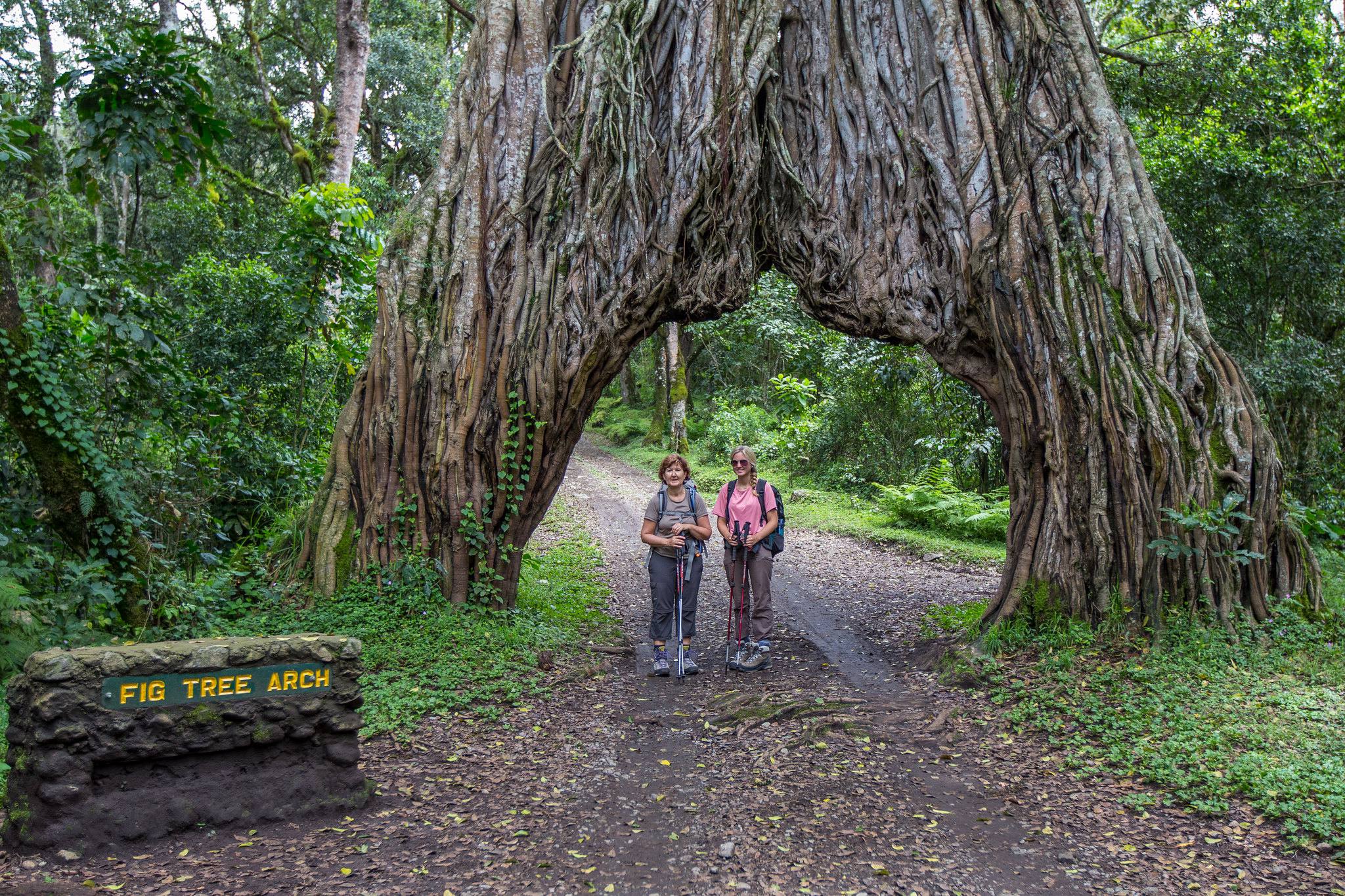
The Fig Tree Arch (Tropical Forest Walk)
A short walk from the main road leads to the Fig Tree Arch – a massive wild fig tree whose roots have grown around a rock, creating a natural archway. This is a popular stop for photos and a good introduction to the highland forest ecosystem.
Best Times to Visit
Dry Season (June – October) – Best for Hiking & Clear Views
The Vibe: Peak season. Best conditions for hiking Mount Meru and walking safaris.
Wildlife: Animals are easier to spot (less vegetation). Flamingos are often present at Momella Lakes.
Weather: Sunny, dry, clear. Best views of Kilimanjaro from Mount Meru.
Reliable trail conditions, excellent visibility, cool hiking temperatures
The park is small, so the few lodges can feel busy
Green Season (November – May) – Best for Birding & Lush Scenery
The Vibe: Secret season. The forest is at its most lush and beautiful.
Wildlife: Birding is at its peak (migratory birds present). Colobus monkeys are active.
Weather: Afternoon showers (especially November and March-May). Trails can be muddy.
Stunning green landscapes, fewer visitors, excellent birdwatching
Mount Meru trails can be slippery; some views of Kilimanjaro may be obscured by clouds
Accommodation & Lodges
Near the Park (Momella Road Area)
Momella Wildlife Lodge: The closest accommodation to the park gate. Simple but comfortable bungalows with views of Mount Meru. Mid-range.
Arusha Coffee Lodge: Located near Arusha city (30 minutes from park). Luxury, coffee plantation setting. Excellent base for day trips.
Kibo Palace Hotel Arusha: Luxury hotel in Arusha city. Great for pre- and post-safari stays.
Mount Meru Hotel: Large, established hotel at the foot of Mount Meru (city location). Good mid-to-upper range.
On the Slopes of Mount Meru (for climbers)
Meru View Lodge: Located near the Momella Gate. Basic but convenient for climbers starting the Mount Meru trek.
Walking tours and camping: Climbing Mount Meru requires camping at huts on the mountain (Miriakamba Hut and Saddle Hut). Your tour operator provides all camping equipment and food.
Budget/Camping Options
Snake Park (Meserani): A budget-friendly campsite with a snake museum, located near Arusha. Popular with overland travelers.
Masai Camp: Basic campsite near Arusha city.
What You Should Know
Park Fees
International Adult: Approximately $60-80 USD per 24 hours (varies by season)
Children (5-15): Approximately $20-25 USD per day
Mount Meru Climbing Fees: Additional fees for the trek (conservation fees, camping fees, guide fees). Expect to pay approximately $300-500 total for a 3-day climb, plus guide/porter tips.
Getting There
By Road:
From Arusha city center: 45 minutes (25 km / 16 miles) via the Momella Road
From Kilimanjaro International Airport (JRO): 45 minutes (35 km / 22 miles)
From Lake Manyara: 2.5 hours (if returning to Arusha)
The roads to the park gate are paved, but roads inside the park are dirt (4×4 recommended)
By Air:
Kilimanjaro International Airport (JRO) is the closest international airport. From there, drive or take a taxi to Arusha and then to the park.
Special Experiences
Walking Safari with Armed Ranger
Arusha National Park is one of the few parks in Tanzania that allows walking safaris (accompanied by an armed ranger). This is a unique opportunity to experience the African bush on foot – tracking animals, learning about insects and plants, and listening to the sounds of the forest. Walks typically last 1.5-3 hours and are available in the forest and around Momella Lakes.
Canoeing on Momella Lakes
A rare experience in Tanzania. Paddle across the shallow, alkaline lakes, surrounded by flamingos, with views of Mount Meru. Canoeing is usually offered as a half-day activity. Note: This requires booking through a tour operator; park authorities have restrictions to protect the ecosystem.
Birdwatching Tours
Arusha National Park is a birder’s paradise with over 400 species. Guided birdwatching walks (or drives) focus on the Momella Lakes (water birds) and the highland forest (forest specialists). The best time is November-March when migratory birds are present.
Camping Experience
The park has designated campsites (e.g., Ngurdoto Campsite) where you can spend the night under the stars. You will hear the sounds of the forest – monkeys, birds, possibly hyenas – and wake up to views of Mount Meru. Your tour operator will arrange all camping gear.
Frequently Asked Questions
Q: Is Arusha National Park worth visiting?
A: Yes, for specific interests. It is not a “Big Five” park, but it offers unique experiences not available elsewhere in the north: walking safaris, canoeing, colobus monkeys, and Mount Meru climbing. It is perfect for a half-day or full-day trip from Arusha, especially for travelers with limited time or those who want to stretch their legs after a long flight.
Q: Can I see the Big Five here?
A: No. There are no lions and no rhinos. You can see elephants (rare), buffalo (common), and leopards (very rare). For the Big Five, visit Ngorongoro Crater.
Q: How does Mount Meru compare to Kilimanjaro?
A: Mount Meru is shorter (4,566 m vs 5,895 m), but the trek is often described as more challenging due to steeper sections and a more technical summit approach. It has fewer crowds, is more affordable, and offers stunning views of Kilimanjaro. Many climbers use Meru as an acclimatization climb before attempting Kilimanjaro.
Q: Do I need a 4×4 vehicle for Arusha National Park?
A: Not strictly required (roads inside the park are basic but often passable for 2WD in dry season). However, a 4×4 is recommended , especially in the rainy season when roads become muddy.
Q: Is there a dress code for the walking safari?
A: Neutral-colored clothing (khaki, green, beige) is required – bright colors disturb wildlife. Long pants and sturdy closed-toe shoes are essential. Your ranger will give specific instructions before the walk.
Q: Can I combine Arusha National Park with other parks in one day?
A: No. Arusha National Park is at least a half-day commitment. It is not near Tarangire or Manyara (2+ hours away). Best visited as a standalone day trip from Arusha.
Q: Is canoeing on Momella Lakes safe?
A: Yes. The lakes are shallow (no crocodiles or hippos in significant numbers). Life jackets are provided. This activity requires booking with a certified tour operator.
Ready to explore the Roof of Africa, the Treehouse of Lions, or Arusha’s Hidden Gem? Book Lake Manyara day trips | Plan your Arusha National Park adventure.
Contact us for a Custom Northern Tanzania Itinerary