
MOUNT KILIMANJARO
The Roof Of Africa
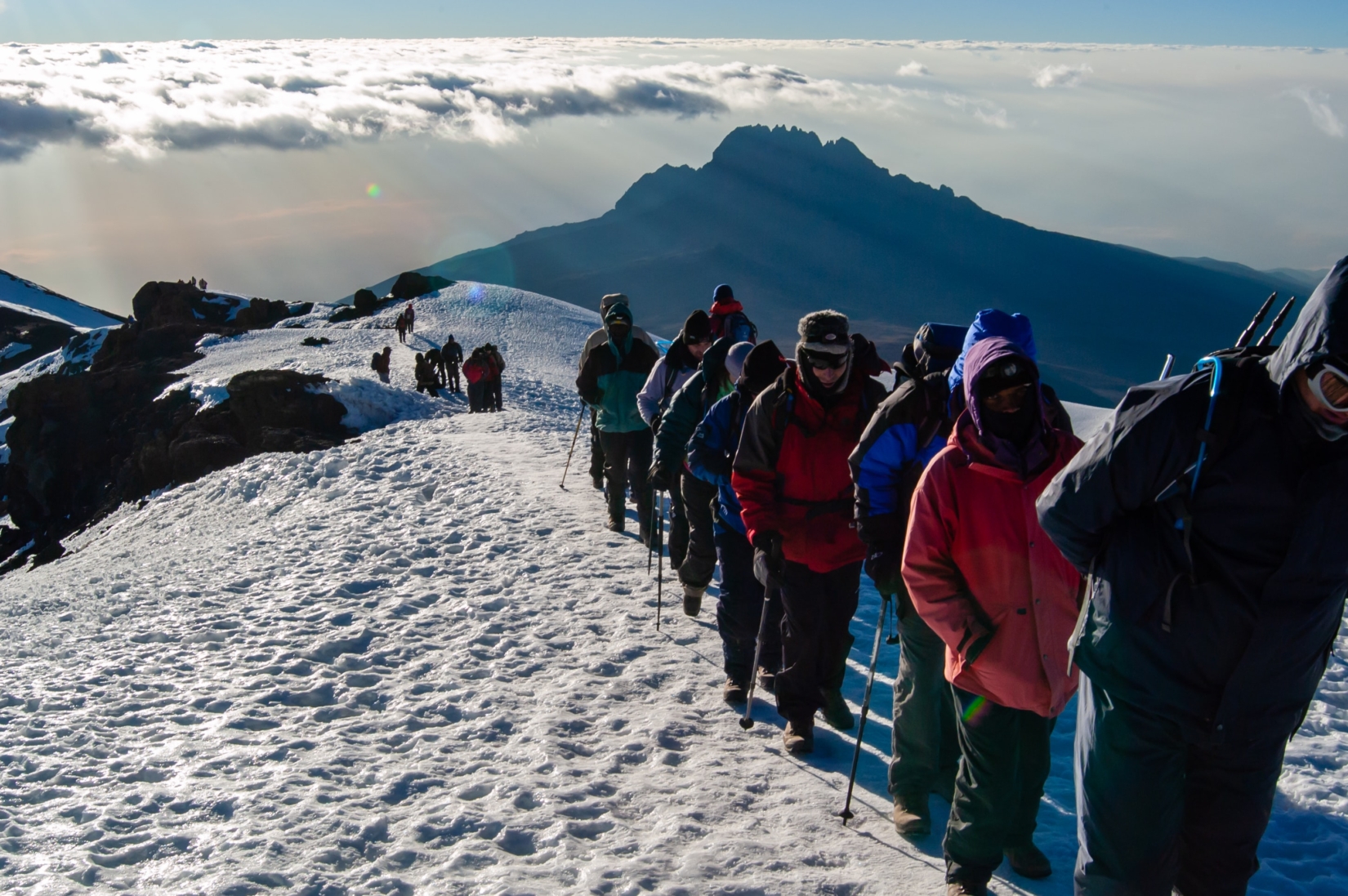
Destination Type: High-Altitude Trekking, Adventure Climbing, Summit Challenge
Location: Northern Tanzania, near the Kenyan border
Famous For: Highest peak in Africa (5,895 m / 19,341 ft), the world’s tallest free-standing mountain, accessible to non-technical climbers
Why the Name "Kilimanjaro"?
The origin of the name “Kilimanjaro” remains a subject of poetic debate, but the most widely accepted explanation combines two words from different languages. In Swahili, “Kilima” means “mountain.” The second part, “Njaro” , is believed to derive from the ancient KiChagga language, meaning “whiteness” or “brilliance.” Together, Kilimanjaro translates to “Mountain of Whiteness” or “Shining Mountain” – a perfect description of its snow-capped summit.
Other theories suggest “Njaro” refers to a mythical demon or a caravan resting place. Regardless of its true linguistic origin, the name evokes the awe that every traveler feels when seeing this solitary giant rising from the savannah.
Geologically, Kilimanjaro is a dormant stratovolcano composed of three distinct cones:
Kibo: The highest summit (5,895 m / 19,341 ft), dormant but could erupt again
Mawenzi: The second highest (5,149 m / 16,893 ft), extinct and ruggedly spectacular
Shira: The oldest and smallest (3,962 m / 13,000 ft), collapsed into a plateau
Where is it Located?
Mount Kilimanjaro is located in northeastern Tanzania, just 60 kilometers (37 miles) from the Kenyan border. The mountain is the centerpiece of Kilimanjaro National Park, a UNESCO World Heritage Site established in 1987.
Nearest City: Moshi (approx. 40 km / 25 miles south) and Arusha (approx. 140 km / 87 miles west)
Nearest International Airport: Kilimanjaro International Airport (JRO) – approximately 45 minutes from Moshi
Access Gates: Machame Gate (southwest), Marangu Gate (southeast), Londorossi Gate (west), Rongai Gate (east)
The mountain is located at 3°4’33″S latitude and 37°21’12″E longitude. Its massive base covers an area of approximately 388,500 hectares (960,000 acres), making it the largest free-standing mountain in the world .
The Seven Climbing Routes: Choosing Your Path
There are seven established routes to climb Kilimanjaro, each with its own character, difficulty, scenery, and success rates. Choosing the right route is the most important decision you will make.
Route 1: Marangu – The “Coca-Cola” Route
Best for: Inexperienced climbers, budget travelers, those who prefer hut accommodation
The Marangu Route is the oldest and most established path on Kilimanjaro . It is often called the “Coca-Cola Route” because of its relative ease and the availability of soft drinks at the huts – a touch of civilization on the mountain.
Key Features:
The only route with sleeping huts (dormitory-style with beds and mattresses) – no tents required
Gradual, gentle slopes make it the most straightforward ascent
Same path used for ascent and descent (less variety in scenery)
Five to six days minimum (shorter acclimatization time lowers success rates)
Route 2: Machame – The “Whiskey” Route
Best for: Adventurous climbers, photographers, those seeking the classic Kilimanjaro experience
The Machame Route, also known as the “Whiskey Route” (the tougher cousin of the “Coca-Cola” route), is the most popular and famous route on Kilimanjaro. It offers stunning, diverse scenery and a much higher success rate than Marangu.
Key Features:
Approaches from the southwestern slope of the mountain
Traverses through five distinct climate zones: rainforest, heath, moorland, alpine desert, and arctic summit
Major landmarks: Shira Plateau, Lava Tower (4,630 m), Barranco Wall (technical but non-dangerous scramble), Barafu Camp
“Climb high, sleep low” profile (acclimatization-focused)
Camping only (tents provided by tour operators)
Route 3: Lemosho – The Scenic Route
Best for: Travelers wanting a balance of scenery, lower crowds, and high success rates
The Lemosho Route is our top recommendation for most climbers. It is a newer route that offers the most spectacular panoramas and a remote wilderness experience before joining the Machame Route for the final ascent.
Key Features:
Starts from the west at Londorossi Gate
First two days trek through rainforest to Shira Plateau (one of Kilimanjaro’s most beautiful areas)
Traverses the plateau from west to east with very few crowds
Merges with the Machame Route near Lava Tower, then follows the Southern Circuit
Excellent acclimatization profile (longer duration = better adaptation)
Route 4: Northern Circuit – The Ultimate Acclimatization Route
Best for: Climbers prioritizing summit success above all else, those seeking solitude
The Northern Circuit is the longest route on Kilimanjaro (9-10 days) and boasts the highest success rate of any route – an impressive 90-95%.
Key Features:
Initially follows the Lemosho Route, then deviates north before Lava Tower
Traverses the rarely visited northern slopes of Kilimanjaro
Offers 360-degree views of the mountain from all sides
Longest distance (approximately 90 km / 56 miles round trip)
Least crowded route on the mountain
Route 5: Rongai – The Fresher Route
Best for: Climbers seeking a different perspective (northern approach), those starting near the Kenyan border
The Rongai Route is the only route that approaches Kilimanjaro from the north (near the Kenyan border). It receives less rainfall than western routes and has a gradual, steady slope.
Key Features:
Starts near the Kenyan border, accessible from Moshi
Passes through unexplored wilderness areas
Less scenic than western routes (drier landscape)
Descent is via the Marangu Route (two perspectives of the mountain)
Good for climbers with little backpacking experience
Route 6: Umbwe – The Hardest Route
Best for: Experienced mountaineers seeking a physical challenge, NOT for beginners
The Umbwe Route is the shortest, steepest, and toughest route on Kilimanjaro. It has the lowest success rate (60-65%) due to its rapid ascent profile and lack of acclimatization time.
Key Features:
Direct, steep approach from the southern slope
Considered the most challenging and dangerous route
Very low traffic (mostly used by guides and rescue teams)
Not recommended for first-time climbers
Route 7: Shira – The High-Altitude Start
Best for: Acclimatized climbers who don’t mind starting at high elevation
The Shira Route begins with a long drive to Shira Camp 1 at 3,500 meters – the highest starting point of any route. This rapid altitude gain makes it risky for unacclimatized climbers.
Key Features:
Merges with Lemosho Route after the first day
Traverses the entire Shira Plateau from west to east
Lower crowds than Machame
Best Times to Climb
Kilimanjaro can be climbed year-round, but certain months offer significantly better conditions.
Dry Seasons (Best for Climbing)
January – Mid-March (Peak Season):
Weather: Clear skies, sunny days, cold nights. Second dry season.
Crowds: High (especially February)
June – October (Peak Season):
Weather: The main dry season. Clear, cold, and dry. Best overall climbing conditions.
Crowds: Very high (especially July-August)
Shoulder Seasons (Good for Budget & Fewer Crowds)
Late March – May (Long Rains):
Weather: Daily afternoon downpours, muddy trails, cloudy skies
Crowds: Very low
November – December (Short Rains):
Weather: Intermittent showers, clearer than March-May, still decent conditions
Crowds: Low
Accommodation on the Mountain Huts (Marangu Route Only)
The Marangu Route is the only route with permanent sleeping huts . These are dormitory-style A-frame buildings with:
Bunk beds with mattresses and pillows
Shared dining huts with tables and benches
Basic toilet facilities
No running water (washing water provided in basins)
Huts are located at Mandara (2,700 m), Horombo (3,720 m), and Kibo (4,700 m).
Camping (All Other Routes)
All other routes require camping in tents. Your tour operator provides:
High-quality, four-season trekking tents
Sleeping mats (foam or inflatable)
Dining tent with table and chairs
Private toilet tent (on higher-end trips)
Camps are located at designated campsites along each route. Some have basic “bathroom” structures (pit toilets), but most require using a portable toilet brought by your operator.
Pre- and Post-Climb Accommodation (Moshi/Arusha)
Most climbers spend 1-2 nights in Moshi or Arusha before and after the climb.
Moshi: Springlands Hotel (popular with Marangu climbers), Kilimanjaro Wonders Hotel, Panama Garden Resort
Arusha: Arusha Coffee Lodge, Mount Meru Hotel, Kibo Palace Hotel
Preparing for the Climb
Physical Fitness Requirements
Climbing Kilimanjaro is non-technical (no ropes, no climbing experience required), but it is a serious physical challenge. You do not need to be an elite athlete, but you should be:
Comfortable hiking 4-8 hours per day for multiple consecutive days
Able to hike on steep, uneven terrain
In good cardiovascular health
Recommended Training:
Begin training 3-6 months before your climb
Focus on hiking with a weighted backpack (10-15 kg)
Include stair climbing, hill repeats, and long weekend hikes (4-8 hours)
Cardiovascular training (running, cycling, swimming) 3-4 times per week
Practice hiking at altitude if possible (visit mountains over 3,000 m)
Acclimatization – The Key to Success
Acute Mountain Sickness (AMS) is the primary reason climbers fail to summit. The “climb high, sleep low” principle is essential.
How to improve acclimatization:
Choose a longer route (8+ days)
Follow the “pole pole” (slowly, slowly) pace – a Swahili phrase you will hear constantly from your guides
Stay hydrated (drink 3-4 liters of water per day)
Avoid alcohol and tobacco on the mountain
Consider taking Diamox (acetazolamide) – consult your doctor before the climb
Listen to your body – headaches, nausea, dizziness, and shortness of breath are early signs of AMS
Summit Night: The final ascent begins around midnight (11:00 PM – 1:00 AM) and takes 5-8 hours to reach Uhuru Peak. Temperatures can drop to -15°C to -25°C (5°F to -13°F) with wind chill. This is the most physically and mentally demanding part of the climb.
Packing List (Essentials)
Clothing (Layering System):
Base layer (merino wool or synthetic, no cotton)
Mid layer (fleece or lightweight puffy jacket)
Outer layer (waterproof and windproof jacket and pants)
Insulated down jacket (for summit night and camp)
Hiking pants (2 pairs) and shorts (1 pair for lower elevations)
Thermal leggings (for cold sections)
Footwear:
Waterproof, broken-in hiking boots (stiff sole, ankle support)
Camp shoes (sandals or lightweight sneakers)
Gaiters (for scree sections and rain)
Accessories:
Warm hat and buff/balaclava (summit night)
Sun hat with wide brim (lower elevations)
Glacier glasses or sunglasses with UV protection and side shields (essential at high altitude – snow blindness is real)
Headlamp with extra batteries (for summit night)
Trekking poles (recommended – saves knees on descent)
Sleeping bag rated to -10°C / 15°F (or lower)
Sleeping pad (if not provided by operator)
Medical & Toiletries:
Prescription medications (with copies of prescriptions)
Diamox (if prescribed)
Broad-spectrum sunscreen (SPF 50+) and lip balm with SPF
Wet wipes and hand sanitizer (no showers on the mountain)
Toilet paper (pack out what you pack in)
Other:
Water bottles or hydration bladder (3-4 liter capacity)
Water purification tablets (if not provided filtered water)
Power bank (limited charging opportunities, mainly at huts on Marangu)
Camera and spare batteries (cold drains batteries quickly)
Special Experiences
Summit Sunrise at Uhuru Peak
The ultimate reward. Climbers who start the summit push around midnight arrive at Uhuru Peak just as the sun rises over the African continent. Standing at 5,895 meters (19,341 feet), watching the glaciers glow pink and orange, with the curvature of the earth visible on the horizon – it is a moment that changes you. Bring your flag for photos; the queue at the summit sign is worth the wait.
The Barranco Wall (Machame, Lemosho, Northern Circuit Routes)
This is NOT a technical climb, but it is a thrilling scramble. The Barranco Wall is a 257-meter (843-foot) rock face that climbers ascend using hands and feet. It looks intimidating from the bottom, but the route is well-worn and safe. The view from the top, looking back at the valley and the “Great Barranco” below, is unforgettable.
The Lava Tower (4,630 m)
A key acclimatization stop on the Machame and Lemosho routes. Climbers hike up to the Lava Tower, a dramatic volcanic plug, then descend to Barranco Camp for the night (“climb high, sleep low”). Many climbers feel the altitude effects here – headaches, nausea, shortness of breath – which is normal and part of the acclimatization process.
The Glaciers of Kilimanjaro
Kilimanjaro’s glaciers are a breathtaking sight – rivers of ancient ice flowing down the slopes of an equatorial mountain. However, they are disappearing. Scientists predict that Kilimanjaro’s ice fields may vanish entirely within 25 years due to climate change. Climbing now offers a chance to see these “shining” glaciers before they are gone forever.
What You Must Know
Visas & Entry Requirements
Tanzania Visa: Required for most nationalities. Apply online for an e-visa (approx. $100) or obtain on arrival at Kilimanjaro International Airport (cash only, USD).
Yellow Fever Vaccination: Required if arriving from an endemic country. Recommended for all travelers.
Travel Insurance: Mandatory and must specifically cover high-altitude trekking up to 6,000 meters. This is non-negotiable – park authorities may ask for proof, and without it, you will not be allowed to climb.
Getting There
By Air:
International flights arrive at Kilimanjaro International Airport (JRO) , located approximately 45 minutes from Moshi and 90 minutes from Arusha.
Airlines serving JRO: Ethiopian Airlines, KLM, Qatar Airways, Turkish Airlines, Kenya Airways, RwandAir, and more.
By Road:
From JRO to Moshi: 45 minutes
From Moshi to Marangu Gate: 1 hour
From Moshi to Machame Gate: 1.5 hours
From Arusha to Londorossi Gate (Lemosho): 3-4 hours
Your tour operator will arrange all transfers from your arrival airport to your hotel and to the park gates.
Frequently Asked Questions
Q: Do I need climbing experience to summit Kilimanjaro?
A: No. Kilimanjaro is a non-technical climb (walking, not climbing). However, you need excellent physical fitness and mental determination. The altitude is the main challenge, not the terrain.
Q: What is the success rate?
A: Average success rates across all routes: 65-70%. Success depends primarily on route choice (longer = higher success) and acclimatization. Northern Circuit has the highest rate (~95%), while Marangu and Umbwe have the lowest.
Q: How cold does it get on summit night?
A: Temperatures at Uhuru Peak range from -10°C to -25°C (14°F to -13°F) with wind chill. Proper layering and a high-quality down jacket are essential.
Q: Can I climb Kilimanjaro alone?
A: No. Tanzanian law requires all climbers to be accompanied by a licensed guide. You can join a group climb (cheaper) or book a private climb (more flexible).
Q: What is the youngest/oldest age to climb?
A: The minimum age is usually 10 years old (with parental consent). The oldest recorded climber was 89 years old. Age is less important than physical fitness and determination.
Q: Do I need Diamox (altitude medication)?
A: Consult your doctor. Many climbers take Diamox to reduce AMS symptoms. It does not “cure” altitude sickness and should not be used as a substitute for proper acclimatization.