Wildebeests and The Great Migration in Serengeti National Park
The Great Migration also known as “The Great Wildebeest Migration” is the most incredible wildlife occurrence on which millions of wildebeests embark on an annual journey across the Serengeti – Mara ecosystem in search for water and green pastures.
The wildebeests and the Great Migration are the highlight of Tanzania wildlife safaris and a reason to why the country as well as Serengeti National Park is visited by millions of tourists with intentions of witnessing millions of wildebeests accompanied by thousands of zebras and gazelles in the endless plains of Serengeti.
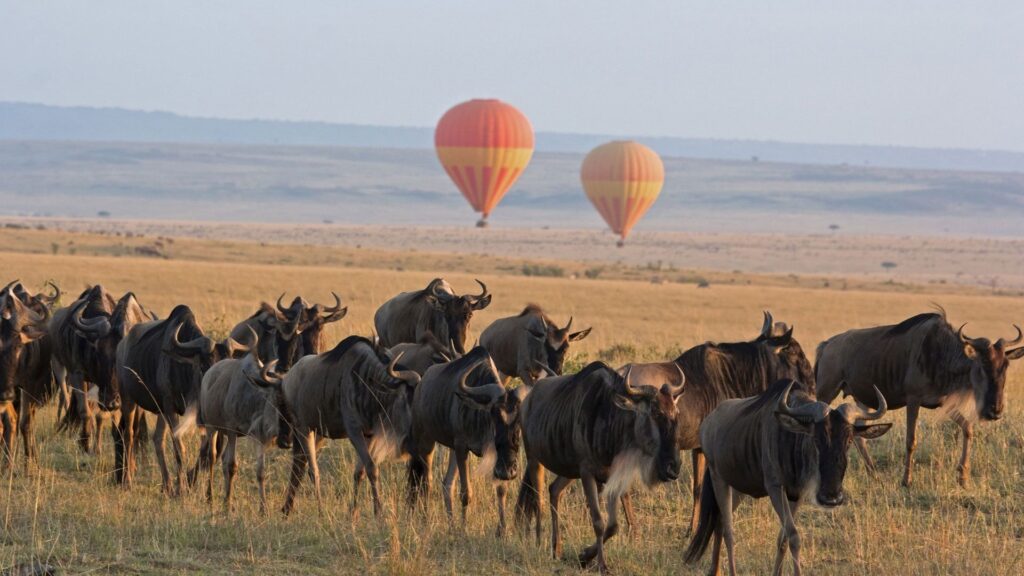
In the local Swahili language, wildebeests are known as Nyumbu. These famous animals are even toed, horned and greyish – brown with striking resemblance to cattle.
Wildebeests are also called “gnus’, they belong to the Bovidae Family which also includes antelopes, cattle and sheep among other even-toed horned ungulates.
In the wildebeest Family, male wildebeests are large then female wildebeests and both have heavy forequarters compared to their hindquarters. They have a large, box – like head with curving horns, their front end of the body is heavily built and the hindquarters are slender with spindly legs. Also, they have a great coat, black mane and a beard in either black or white.
At maturity, wildebeests can grow to reach the length of 8 feet and 4.5 feet tall and the shower, both males and females grow horns and they can weight up to 600 pounds.
There are several species of wildebeests and the specie found in Serengeti-Mara ecosystem which takes part in the Great Wildebeest Migration are the “Western White-bearded wildebeests”, in the east of the Gregory Rift in Kenya and Tanzania, there are the eastern white bearded species and the brindled or blue wildebeests in South of the Zambezi River.
The name GNU pronounced as “g-new” by the Afrikaans because of their menacing appearance presented by its large head, shaggy mane, pointed beard and sharp, curved horns.
Wildebeests are best described as a reliable source of food for the predators such as lions, cheetahs, wild dogs, hyenas and leopards.
Behavior and Diet of Wildebeests
In nature, the wildebeests are more driven by their appetites through their lives. Because of their large size, the continuously move in search for favorable supplies of grass and water. The famous population of wildebeests in Serengeti plains is a very large nomadic group which is why they make a migratory journey of 800 to 1,610 wildebeests each year. Their annual journey begins right after the calving season at the start of the year.
The wildebeests are always very restless in their journey and many of them get injured and lose their lives most especially calves that get killed by predators such as lions, leopards, hyenas and the high currently water of the river.
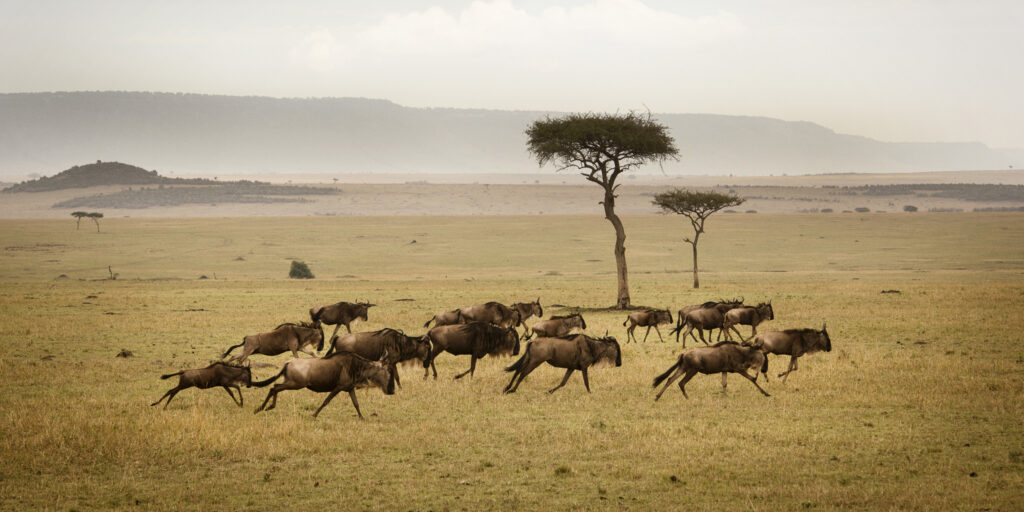
By the end of the dry season, the wildebeests have almost exhausted the grazing lands in the Mara – Serengeti Ecosystem and embark on their return to Serengeti national park at the start of the rain.
Quick Facts About Wildebeests
- Wildebeests are very noisy creatures
- Bulls have a wide array of loud vocalizations from moans to explosive snorts
- The majority of female wildebeests gave birth around the same time
- About 80 percent of the female calves are withing the same two-to-three-week period, this creates a glut for predators and enables more claves to survive the crucial first weeks after their birth
Habitat and Range of Wildebeests
The habitat of the wildebeests comprises of the grassy plains and open woodlands of central, southern and East Africa particularly in the Serengeti National Park in Tanzania and Masai Mara National Reserve.
The Wildebeests move in large numbers known as herds and are active day and night grazing constantly.
Migration
The wildebeests embark on an annual journey across the savannah plains of Serengeti – Mara Ecosystems in search for water and green pasture, they move following an old route and their movement is dictated by weather patterns.
The Wildebeest Migration is considered one of the greatest wildebeest spectacles on Earth involving over 2 million wildebeests as well as hundreds of thousands of zebras and gazelles both Thomson and Grants.
Population
During the calving season is happens in February and March each year that is at the beginning of the rainy season, over 500,000 calves are born. Calves learn to walk within minutes after their birth and within a day they are able to keep up with the herd.
Wildebeests have a life span of up to 20 years old
The Great Migration
The Great Migration also referred to as The Great Wildebeest Migration is an annual continuous movement over 2 millions of wildebeests accompanied by thousands of zebras and gazelles in search for food and water. The movement of these animals happens in sections of Serengeti National Park at a different time of the year, the most recognized as a trans-destination between Serengeti National Park in Tanzania and Masai Mara National Reserve “The Mara – Serengeti Eco System” passing through Mara River East of Grumeti River Valley through Lobo.
The major highlight of a Tanzania wildlife safari is The Great Migration which attracts millions of tourists to witness this incredible event of wildlife ere more thatn 2 million wildebeests, 250,000 zebras and 300,000 gazelles migrate through the Mara- Serengeti ecosystem driven by an instinct of survival.
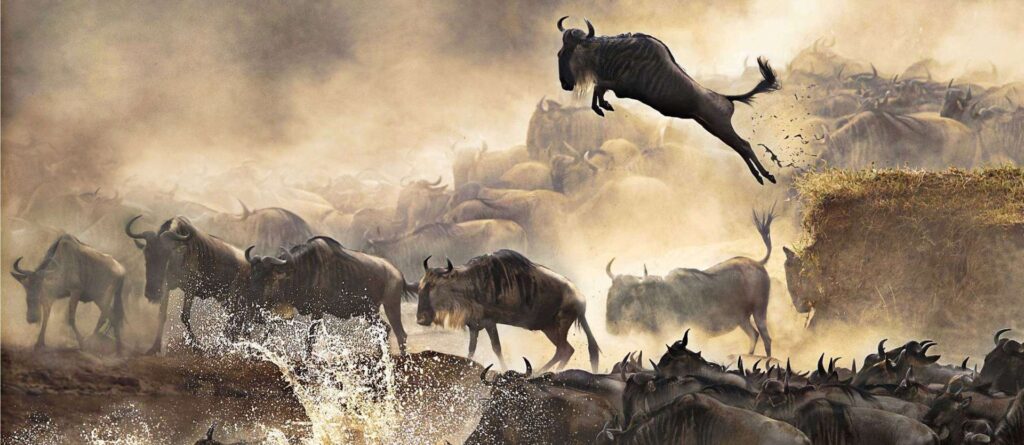
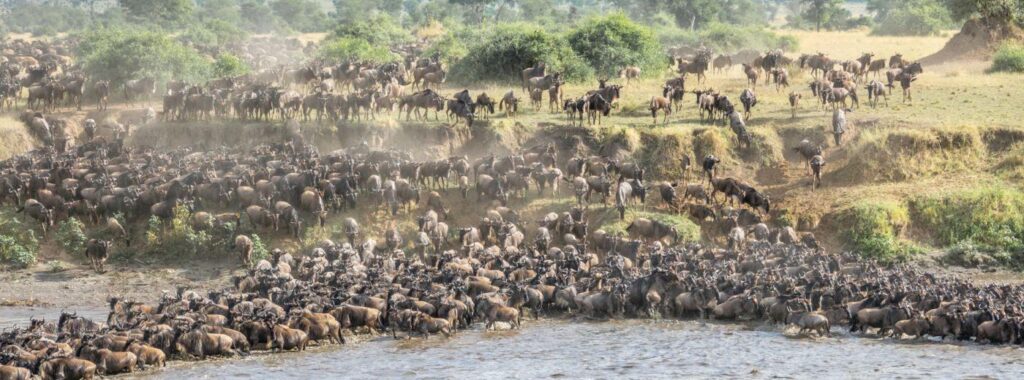
The Wildebeest Migration is more dramatic as the wildebeests and other grazers that is zebras and gazelles are seen throwing themselves into waters of the Mara River which is infested with fierce Nile crocodiles. Some of the animals are washed away by the running waters and others fall victim to the Nile Crocodiles and predators like lions, leopards, cheetahs and African wild dogs along the river.
Mara River crossing is a moment of survival for the fittest and once the animals make it into the waters, there is no turning back. The Great Migration is the largest migration of land animals on earth and is considered as one of the greatest spectacles in the natural world.

Southern Serengeti Wildebeest Migration
The Southern Serengeti Wildebeest Migration begins in late December with a climax in January that is before the wildebeests start on their return journey in March to the Central part of Serengeti.
This episode of the migration is referred to as “The Calving Season” and happens in the Southern part of Serengeti and in the Northern part of the Ngorongoro Conservation Area in the Ndutu region.
The wildebeests, zebras, kobs and gazelles, gather and build up a strong team to give birth to young ones.
During the calving season, over 1,000 young ones are born on a daily basis, the presence of these vulnerable young ones attracts a lot of predators to feast on them.
Western Serengeti Wildebeest Migration
The Western Serengeti Wildebeest Migration occurs at around April to early June during the rainy season, large herds of grazers such as elands, zebras, gazelles led by the wildebeest move around the western corridor of Serengeti – South of Grumeti River.
The Western Serengeti Wildebeest is one of the deadliest migration in Serengeti due to the high concentration of predators such as Nile crocodiles, leopards, lions, cheetahs and African wild dogs.
During this stage of the Great Migration, hundreds of wildebeests lose their life during the migration more than any episode of the migration.
Northern Serengeti Wildebeest Migration
The Northern Serengeti Wildebeest Migration happens from July to September as the animals cross Mara River in attempts to enter the plains of Masai Mara National Reserve of Kenya, this is the most spectacular of the Great Migration and is listed as one of the seven wonders of animals on earth.
It takes place in the extreme north of Serengeti National Park around Lamai Triangle and is the largest and the mass wildebeest migration, the wildebeests are seen throwing themselves in water amidst Nile Crocodiles. This is the most spectacular part of this migration, however no one can tell the exact date the wildebeests are going to cross the river. The predators can camp there just in time waiting for the great opportunity.
If you are planning to witness the migration, you can visit Serengeti National Park in July and return back to Masai Mara in October to witness the full episode.