
When Is The Great Migration in Tanzania?
The Great Migration in Tanzania sees over a million wildebeest travelling over 1,000 miles each year, closely followed by thousands of zebras and gazelles. These animals make this journey in search of fresh water and expansive grasslands, the spectacle of vast herds traversing varying terrains is an astonishing sight.
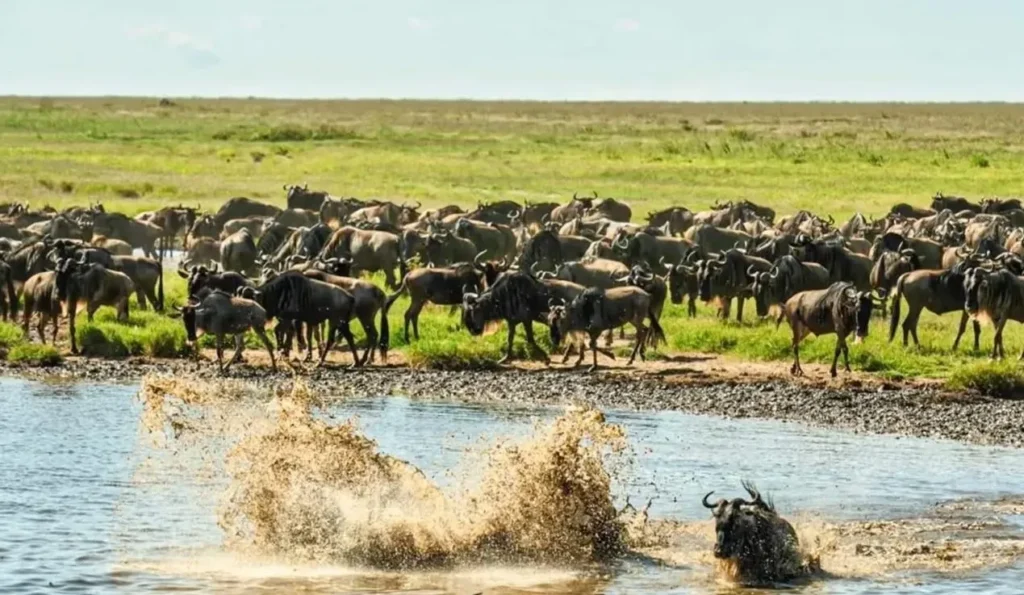
Though often believed to be an annual event, The Great Migration is a continuous process, meaning the animals follow a constant clockwise circuit with the weather and the natural instincts of the wildebeests serving as a guide.
The journey is not an easy feat for these creatures as it can prove deadly for some, particularly the calves. Along the way, the animals are met with a slew of hungry predators, with lions, cheetahs, African wild dogs and leopards ready and waiting to pounce on the vulnerable and young. Not only that, but the tiresome and challenging expedition can leave many of the animals weak, meaning thousands of wildebeests, zebras, and gazelles are left behind.
Although expansive savannahs and dense woodlands up a great deal of the Serengeti Great Migration, the animals must also tackle multiple river crossings. The most famous of these is the Mara River, in which many lose their lives to the rough currents of the fast flowing river and resident crocodiles.
Best Time to See The Great Migration in Tanzania
The Great Migration is an annual cycle, meaning you will have the opportunity to marvel at the migrating herds any time of year. However, it is not possible to narrow down specific dates for the Great Migration in Tanzania, as every year is a little different. However, the information below shows what you can expect to see on the timing of your visit.
January – March
At the beginning of the year, most of the herds flock to the abundant green grasses near the Ngorongoro Crater. It’s here that hundreds and thousands of calves are born, with calving peak in February.
April – May
The herds begin to move north and the mating season starts in May. At this time, many males can be seen competing for mates as they head towards central Serengeti.
June – August
By June, the dry season has begun and the animals must continue to Northern Serengeti. During these months, these animals must face their most daunting tasks yet and cross the crocodile-plunged waters of the Grumeti and Mara Rivers. For this reason, many consider August, in particular, to be the optimum timing for the Great Migration in the Serengeti.
September – October
Once September arrives, most the animals have attempted the formidable Mara River Crossing and those that are successful will make their way to the Maasai Mara region of Kenya.
November – December
When the rains begin to simmer down in November, the herds return south and journey back towards the Serengeti. At this time, the short rainy season supplies the herds with lush green pastures, providing ideal conditions for the calving season to begin once again.
Why Does The Great Migration Occur?
The Great Migration in Serengeti occurs as the wildebeests embark on an annual journey seeking out nutritious grass to feed on, moving according to the rainfall.
At the beginning of each year, the rainfall in southern Serengeti brings bountiful grassy landscapes to the region, attracting the animals as the calving season approaches. As the months pass, the rains move north and the animals follow suit to ensure they have a steady supply of food and water.
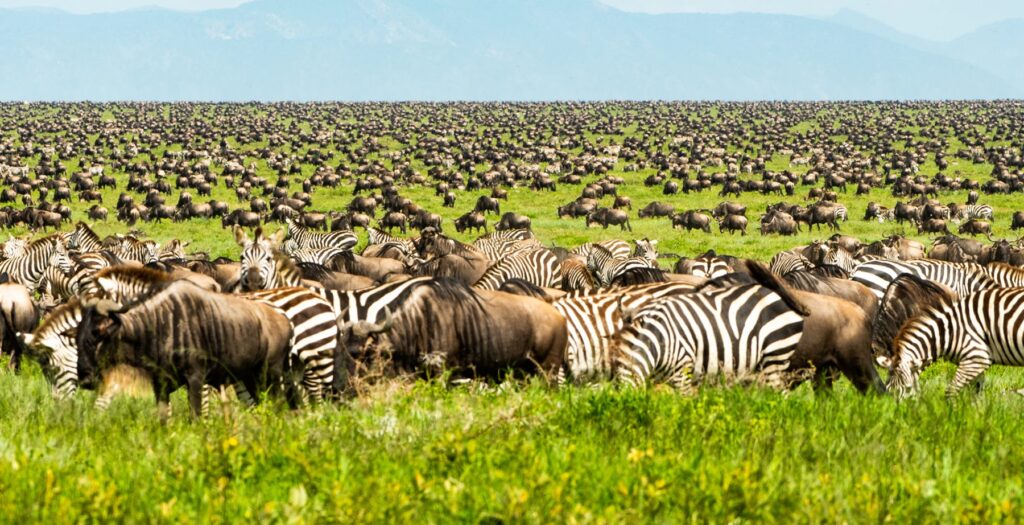
Though all the animals move on a quest to locate green pastures and water, the wildebeests and gazelles prefer short grasses, while the zebras tend to go for longer alternatives. This allows animals to move together rather harmoniously and each species also boasts different strengths that help the herds seek out potential threats. For example, wildebeests utilize their sense of smell to identify food, while zebras have excellent sight for spotting predators.
Despite the thousands of wildebeests, zebras and gazelles that are lost along the way, each animal must take the risk, as their herbivores diets primarily consist of grass.
Where Does the Great Migration Start and End?
In reality, the Great Migration in Serengeti is never-ending but it is typically described as beginning from the southern Serengeti of Tanzania and ending in the Maasai Mara in Kenya.
At the start of each year, the Ngorongoro Crater and its surrounding areas have ample grass for the animals to feed on. By April, they must venture toward Central Serengeti as the rains progress to the North. The animals continue to chase the rainfall, heading west and cross the Grumeti River. Afterward, they must go across the Mara River and the lucky survivors will get to savor the rich grasses of the Maasai Mara.
Around late October, the rains lures the animals back to the southern Serengeti, and the pattern carries on.
With each passing year, the precise route of the Great Migration in Africa’s east can change a little based on the weather conditions that dictate the animals’ exact movements. For this reason, it is challenging to pinpoint specifically where the animals will be at any given time.
How To See the Great Migration?
Before you decide on where you want to see the Great Migration, it is important to be aware that it is a continuous happening that takes place at different locations through the year. This means the time of the time you visit Tanzania will depend on where to go to see the Great Migration as it takes place. For example, say you come during the dry season between June and August, you will have to head toward the northern Serengeti to witness the movement.
Hiring an experienced Tour Provider like USOKE Explorers is your best chance of seeing the Great Migration in Tanzania. Our Tanzania Travel Experience will recommend some of the finest spotting locations along the typical Great Migration Route, where they can see zebras, grant’s gazelle and much more.
What sets us apart from other travel companies is our focus on positively impacting wildlife conservation.
What Animals Can You See During the Great Migration?
The Great Migration in Tanzania is a specific type of animal migration with only certain animal species participating.
While about two million animals take part in the Great Migration, many of these are wildebeests. However, lots of thomson’s and grant’s gazelles, zebra, impala and eland join up with the wildebeests to take on the treacherous 1,200 mile journey.
These over two million animals do not migrate in one herd, there is a common misconception that they all move together, but that is not true. Instead, they move in groups. That should don’t disappoint you, as this an outstanding experience and you will still see plenty of them moving in large groups.
The animals have to move together to keep each other safe from opportunistic animals hunting for prey like lions and hyenas. So, if you do catch a couple of them on the go, you can bet there is plenty more coming from behind.
Inclusion – When is the Great Migration in Tanzania?
The Great Migration is one of the most incredible spectacles that attract thousands of visitors to Tanzania every year. Now that you know when the Great Migration is in Tanzania, you can start organizing your Great Migration to Tanzania.
Planning a safari around the time of the Great Migration without experience is a tricky task. Thankfully your Tanzania Safari Experts are available 24/7 to help you.